How to Calculate Gratuity in UAE for Unlimited Contract
Employees searching for how to calculate gratuity in UAE for unlimited contract should first understand one major legal change. Traditional unlimited employment contracts are no longer used for UAE private-sector employment under the current Labour Law.
Existing unlimited contracts were converted to fixed-term contracts. However, employees who originally joined under an unlimited contract do not lose their previous service period. Their end-of-service gratuity is generally calculated using their full eligible service and the current UAE gratuity formula.
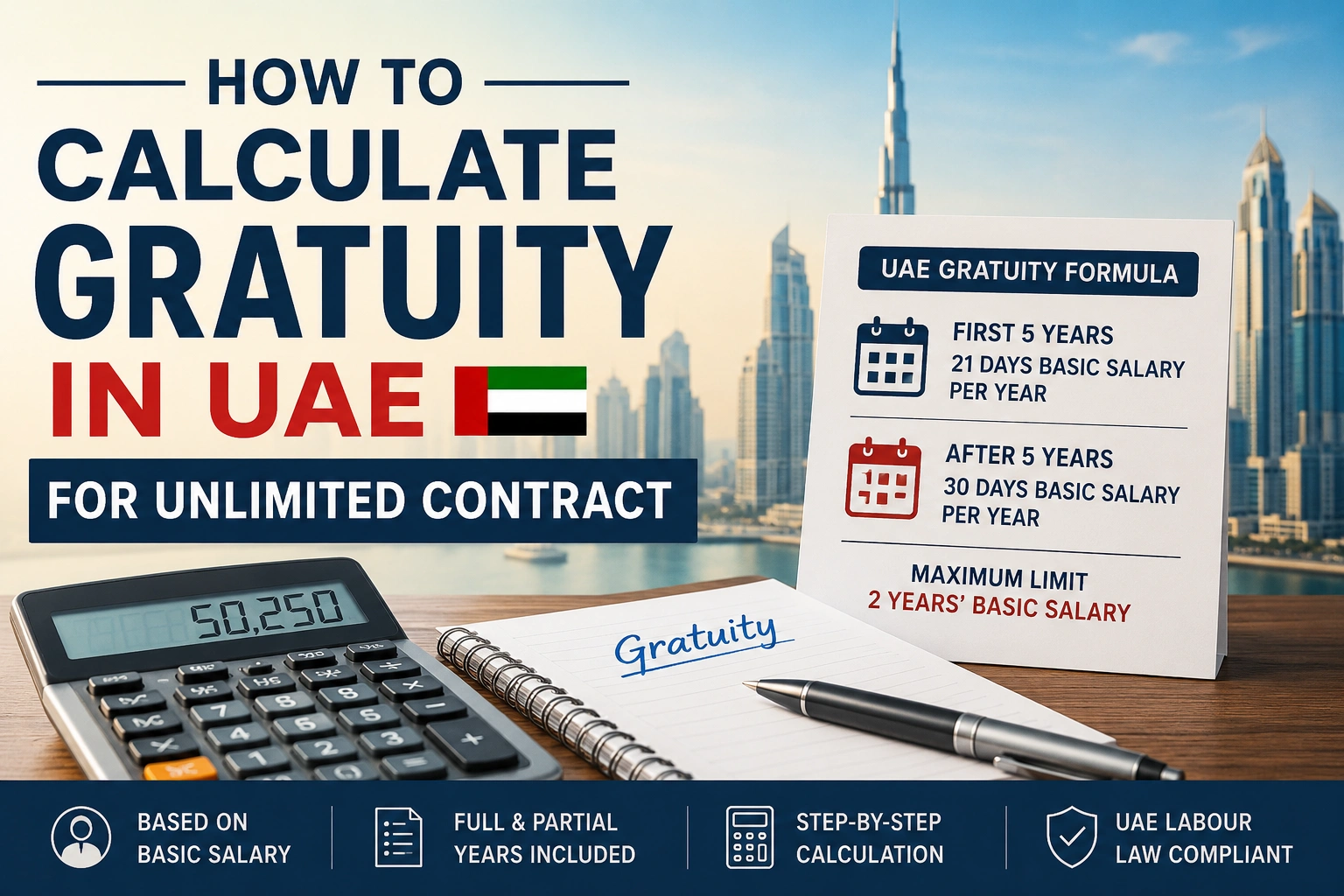
For most full-time expatriate employees, the calculation is:
- 21 days of basic salary for each year during the first five years
- 30 days of basic salary for each year after five years
- No gratuity for service of less than one continuous year
- Maximum gratuity of two years’ wage
The calculation is based on the employee’s last basic salary, not the total monthly package.
Quick UAE Unlimited Contract Gratuity Formula
Here is the simplest formula for calculating end-of-service gratuity:
For One to Five Years of Service
Gratuity = Daily basic salary × 21 × completed years of service
For More Than Five Years of Service
Gratuity = First five years’ entitlement + entitlement for additional years
The full formula is:
Daily basic salary × 21 × 5
Plus:
Daily basic salary × 30 × years beyond five
To calculate the daily basic salary:
Monthly basic salary ÷ 30
Partial years are generally calculated proportionately after the employee completes at least one continuous year of service.
Are Unlimited Contracts Still Valid in the UAE?
Unlimited contracts were part of the previous UAE Labour Law. They did not contain a predetermined employment end date and continued until either the employer or employee ended the relationship.
The current private-sector Labour Law introduced fixed-term employment contracts. As a result, old unlimited contracts had to be converted into fixed-term arrangements.
This change does not mean that gratuity earned during an old unlimited contract disappears. An employee’s continuous service normally runs from the original joining date, provided there was no legal break in employment.
For example, an employee who joined under an unlimited contract in 2018 and remained with the same employer until 2026 may have eight years of continuous service. The gratuity should not normally be calculated only from the date the contract was converted.
Current Gratuity Rules for Former Unlimited Contracts
Under the current rules, the old distinction between limited and unlimited contracts is generally no longer used to calculate gratuity for private-sector employees.
The key factors are now:
- Last basic salary
- Eligible length of service
- Full-time or alternative work pattern
- Unpaid absence
- Applicable employment jurisdiction
- Participation in an alternative end-of-service savings scheme
- Any legally recoverable amounts owed to the employer
The former resignation reductions associated with unlimited contracts should not be applied to employment ending under the current law.
Old Unlimited Contract Rules vs Current UAE Rules
Many online articles still publish the old resignation formula. This can produce a much lower gratuity estimate than the amount calculated under the current Labour Law.
| Length of service | Old unlimited-contract resignation rule | Current general rule |
|---|---|---|
| Less than 1 year | No gratuity | No gratuity |
| 1 to 3 years | One-third of gratuity | Full statutory gratuity |
| More than 3 to 5 years | Two-thirds of gratuity | Full statutory gratuity |
| More than 5 years | Full gratuity | Full statutory gratuity |
| Calculation basis | Last basic salary | Last basic salary |
Under the previous system, an employee resigning after two years might have received only one-third of the standard amount. That reduction is not part of the current Article 51 calculation for eligible full-time private-sector employees.
How to Calculate Gratuity in UAE for Unlimited Contract Step by Step
Step 1: Find Your Last Basic Salary
Check your employment contract, latest payslip or official salary breakdown. Use the amount identified as basic salary.
Do not automatically use the full amount deposited into your bank account. Your total salary may include several allowances that are excluded from the gratuity calculation.
Step 2: Exclude Allowances and Benefits
UAE gratuity is normally calculated on basic salary only. Common exclusions include:
- Housing allowance
- Transport allowance
- Food allowance
- Utility allowance
- Schooling allowance
- Mobile phone allowance
- Commission, unless contractually treated as part of basic wage
- Overtime payments
- Bonuses
- Reimbursements
- Benefits in kind
For example, an employee may receive AED 10,000 per month, consisting of AED 6,000 basic salary and AED 4,000 allowances. The gratuity calculation would normally use AED 6,000.
Step 3: Calculate Your Daily Basic Salary
Divide the last monthly basic salary by 30.
Daily basic salary = Monthly basic salary ÷ 30
If the basic salary is AED 6,000:
AED 6,000 ÷ 30 = AED 200 per day
Step 4: Calculate Eligible Service
Count the period from the official employment start date to the final employment date.
Include the notice period when it forms part of the continuing employment relationship. Exclude unpaid absence when calculating the eligible service period.
Paid annual leave, public holidays and normal paid sick leave do not usually create a break in continuous employment.
Step 5: Apply the Correct Gratuity Rate
Use 21 days of basic salary per year for the first five years.
For every year after the fifth year, use 30 days of basic salary.
| Eligible service | Gratuity rate |
|---|---|
| Less than 1 year | No gratuity |
| 1 to 5 years | 21 days per year |
| More than 5 years | 21 days per year for the first 5 years, then 30 days per additional year |
Step 6: Add the Proportion for a Partial Year
After completing at least one year, an employee is generally entitled to gratuity for an additional fraction of a year.
A practical calculation is:
Annual gratuity entitlement × eligible fraction of the year
For six additional months:
Annual entitlement × 6 ÷ 12
For 120 additional eligible days:
Annual entitlement × 120 ÷ 365
Using the exact number of eligible days is usually more accurate than rounding the service period to full months.
Step 7: Check the Maximum Gratuity Limit
The total statutory gratuity cannot exceed the equivalent of two years’ wage under the applicable formula.
This cap usually affects only employees with very long service periods. Most employees leaving after a few years will remain well below the maximum.
Step 8: Account for Permitted Deductions
An employer may deduct amounts that the employee legally owes, subject to the Labour Law and supporting records.
Possible deductions may include:
- Outstanding employee loans
- Salary advances
- Recoverable overpayments
- Amounts ordered by a court
- Other legally established debts
An employer should not make unexplained or unsupported deductions from gratuity.
You can also use the Gratuity Calculator UAE tool to know your end-of-service benefits.
Example 1: Gratuity After Two Years
Assume:
- Monthly basic salary: AED 5,000
- Total service: 2 years
- Employment ended by resignation
- No unpaid absence
Calculation
Daily basic salary:
AED 5,000 ÷ 30 = AED 166.67
Annual gratuity:
AED 166.67 × 21 = AED 3,500.07
Gratuity for two years:
AED 3,500.07 × 2 = AED 7,000.14
The small difference caused by decimals may be rounded according to the employer’s payroll calculation.
Under outdated unlimited-contract rules, some calculators may reduce this amount because the employee resigned before completing three years. That reduction should not be used under the current general private-sector formula.
Example 2: Gratuity After Four Years and Six Months
Assume:
- Monthly basic salary: AED 8,000
- Eligible service: 4 years and 6 months
- No unpaid absence
Calculation
Daily basic salary:
AED 8,000 ÷ 30 = AED 266.67
Gratuity for four complete years:
AED 266.67 × 21 × 4 = AED 22,400.28
Gratuity for six additional months:
AED 266.67 × 21 × 6 ÷ 12 = AED 2,800.04
Estimated total gratuity:
AED 22,400.28 + AED 2,800.04 = AED 25,200.32
Using an unrounded daily salary during the calculation gives an exact total of approximately AED 25,200.
Example 3: Gratuity After Seven Years
Assume:
- Monthly basic salary: AED 9,000
- Eligible service: 7 years
- No unpaid absence
First Five Years
Daily basic salary:
AED 9,000 ÷ 30 = AED 300
First five years:
AED 300 × 21 × 5 = AED 31,500
Additional Two Years
AED 300 × 30 × 2 = AED 18,000
Total Gratuity
AED 31,500 + AED 18,000 = AED 49,500
The employee receives 21 days per year for the first five years and 30 days per year only for the two years exceeding five.
Example 4: Gratuity After One Year and Three Months
Assume:
- Monthly basic salary: AED 4,500
- Eligible service: 1 year and 3 months
- No unpaid absence
Daily basic salary:
AED 4,500 ÷ 30 = AED 150
Gratuity for one year:
AED 150 × 21 = AED 3,150
Gratuity for three additional months:
AED 150 × 21 × 3 ÷ 12 = AED 787.50
Estimated gratuity:
AED 3,150 + AED 787.50 = AED 3,937.50
The employee qualifies because the initial one-year eligibility threshold has been completed.
Example 5: Employee Leaves Before Completing One Year
Assume:
- Monthly basic salary: AED 7,000
- Service period: 11 months and 20 days
The employee is generally not entitled to statutory end-of-service gratuity because one continuous year has not been completed.
Other final-settlement amounts may still be payable, including outstanding salary, approved expenses and payment for unused annual leave.
UAE Gratuity Calculation Table
The table below shows approximate gratuity based on complete years of service.
| Basic salary | 2 years | 5 years | 7 years | 10 years |
|---|---|---|---|---|
| AED 3,000 | AED 4,200 | AED 10,500 | AED 16,500 | AED 25,500 |
| AED 5,000 | AED 7,000 | AED 17,500 | AED 27,500 | AED 42,500 |
| AED 8,000 | AED 11,200 | AED 28,000 | AED 44,000 | AED 68,000 |
| AED 10,000 | AED 14,000 | AED 35,000 | AED 55,000 | AED 85,000 |
| AED 15,000 | AED 21,000 | AED 52,500 | AED 82,500 | AED 127,500 |
These figures assume full-time employment, no unpaid absence, no deductions and no participation in an alternative savings scheme.
Does Resignation Reduce Gratuity Under an Unlimited Contract?
Resignation does not generally reduce statutory gratuity under the current private-sector Labour Law.
An eligible employee who resigns after completing at least one continuous year normally receives gratuity using the same 21-day and 30-day rates. The old one-third and two-thirds resignation rules belong to the previous unlimited-contract system.
The employee must still follow the required notice period and contractual exit procedure. A separate dispute over notice pay, loans or other liabilities may affect the final settlement, but it does not restore the old resignation reduction formula.
Is Gratuity Different When an Employer Terminates the Employee?
The basic gratuity formula is generally the same for resignation and employer-initiated termination.
An eligible employee receives:
- 21 days of basic salary for each of the first five years
- 30 days of basic salary for each additional year
- A proportionate amount for an eligible partial year
Termination may create other entitlements depending on the circumstances. These can include notice pay, unused annual leave, outstanding salary or compensation ordered in an employment dispute.
Can an Employee Lose Gratuity After Dismissal?
Employers should not assume that every dismissal automatically cancels gratuity. The current Labour Law separates the grounds for dismissal from the statutory method used to calculate end-of-service benefits.
The final entitlement depends on the facts, the applicable legal provisions and any proven employee liabilities. Where misconduct, financial loss or an employment dispute is involved, the employee should request a detailed written final-settlement calculation rather than relying on a verbal explanation.
How Unpaid Leave Affects Gratuity
Days of absence without pay are excluded from the service period used for gratuity.
For example, an employee may have worked from January 1, 2022, to January 1, 2025, but taken 60 days of unpaid leave. The calendar period is three years, while the eligible service used for gratuity may be reduced by those 60 days.
This adjustment can affect both:
- The employee’s total eligible service
- The proportionate gratuity for the final incomplete year
Keep copies of approved unpaid-leave requests and payroll records to confirm the deduction.
Is the Notice Period Included in Gratuity Service?
A notice period normally remains part of employment when the employee continues working or receives contractual notice treatment until the official termination date.
The service end date shown on the employment cancellation and final records should therefore be checked carefully. Gratuity should not automatically stop on the day the resignation letter is submitted.
If the employer pays compensation instead of requiring the employee to work the notice period, the legal and contractual treatment of the termination date should be confirmed through the final settlement.
Which Salary Is Used When Basic Pay Changes?
Gratuity is generally calculated using the employee’s last basic salary.
It is not normally divided into separate calculations for each historical salary level. For example, an employee whose basic salary increased from AED 5,000 to AED 8,000 would usually have the eligible service calculated using the final basic salary of AED 8,000.
A salary increase must be genuine and reflected in the employment and payroll records. Disputes can arise when the contractual basic salary differs from the amount shown on payslips or salary-transfer records.
What Is Included in the Final Settlement Besides Gratuity?
End-of-service gratuity is only one component of an employee’s final settlement.
Depending on the circumstances, the settlement may include:
- Salary up to the final working date
- End-of-service gratuity
- Payment for unused annual leave
- Notice pay
- Approved unpaid expenses
- Contractual commission or bonus
- Repatriation entitlement where applicable
- Deductions for legally established debts
Each amount should appear separately on the final-settlement statement. Employees should avoid signing a document stating that all dues were received before checking the calculation and actual payment.
When Must the Employer Pay UAE Gratuity?
An employer must generally pay outstanding wages, gratuity and other end-of-service entitlements within 14 days from the end of the employment contract.
Employees should request:
- A written breakdown of the calculation
- The basic salary used
- The eligible service dates
- Details of unpaid days excluded
- An explanation of every deduction
- The expected payment date
Keeping the final settlement in writing makes it easier to identify a calculation error or raise a labour complaint.
Who Is Covered by the Standard UAE Gratuity Formula?
The standard formula primarily applies to eligible expatriate employees working full-time in the UAE private sector under the federal Labour Law.
Different rules or systems may apply to:
- UAE and GCC nationals covered by pension systems
- Domestic workers
- Federal or local government employees
- Employees in the Dubai International Financial Centre
- Employees in Abu Dhabi Global Market
- Part-time or job-sharing employees
- Workers enrolled in an approved alternative end-of-service savings scheme
Most free-zone employees are covered by the federal Labour Law, but DIFC and ADGM operate separate employment frameworks.
Gratuity for Part-Time and Flexible Employees
Employees working under part-time, flexible or job-sharing arrangements may receive an end-of-service benefit calculated proportionately.
The calculation considers the employee’s contracted working hours compared with full-time working hours. This percentage is then applied to the full-time gratuity amount.
A standard full-time gratuity calculator may therefore produce an inaccurate result for an employee working under another approved work pattern.
Alternative End-of-Service Savings Scheme
Some employers may join the UAE’s voluntary alternative end-of-service benefits system. Under this arrangement, the employer makes contributions to an approved investment fund instead of building the traditional gratuity liability for the employee’s future service.
Once an employee is registered, the traditional gratuity is normally calculated for service completed before the scheme registration date. Contributions under the savings scheme then apply to the later service period.
Employees enrolled in the scheme should review:
- Registration date
- Employer contribution records
- Value of invested funds
- Gratuity earned before registration
- Withdrawal conditions
- Any voluntary employee contributions
Common UAE Gratuity Calculation Mistakes
Using Gross Salary Instead of Basic Salary
The most common error is multiplying the formula by the employee’s full salary package. Housing, transport and most other allowances are excluded.
Applying the Old Resignation Reduction
Some outdated calculators still award one-third or two-thirds gratuity to employees resigning from unlimited contracts. This does not reflect the current general private-sector calculation.
Giving 30 Days for Every Year After Five Years
An employee with seven years of service does not receive 30 days for all seven years. The first five years remain calculated at 21 days each, while only the final two years receive 30 days each.
Ignoring the Partial Year
Once an employee has completed the first continuous year, an eligible additional fraction should generally be calculated proportionately.
Counting Unpaid Absence
Unpaid absence is excluded from eligible service. Failing to deduct it can slightly overstate the final amount.
Starting Service From the Contract-Conversion Date
Employees originally hired under unlimited contracts should not normally lose earlier continuous service merely because the contract was later converted to a fixed term.
Using the Wrong Jurisdiction
DIFC, ADGM, domestic-worker and government employment may follow different rules. The federal private-sector formula should not be applied automatically to every worker in the UAE.
Documents Needed to Verify Your Gratuity
Collect the following records before accepting the final settlement:
- Original employment contract
- Updated fixed-term contract
- Official joining date
- Latest payslip
- Salary certificate
- Bank salary records
- Resignation or termination letter
- Notice-period details
- Approved unpaid-leave records
- Annual-leave balance
- Employment cancellation documents
- Written final-settlement breakdown
These documents help confirm the correct basic salary, continuous service period and deductions.
What to Do If the Gratuity Amount Is Incorrect
Start by asking the employer or HR department for a written calculation. Compare its figures with your contract, payslip and eligible service dates.
Check these four points first:
- Was the last basic salary used?
- Was service counted from the original joining date?
- Were only genuine unpaid absences excluded?
- Were outdated resignation reductions applied?
If the difference is not corrected, an employee covered by the federal private-sector system may raise the matter with the Ministry of Human Resources and Emiratisation. Employees in a separate jurisdiction should use the dispute process applicable to that jurisdiction.
Frequently Asked Questions
How do I calculate gratuity in UAE for an unlimited contract?
To understand how to calculate gratuity in UAE for unlimited contract employment, divide the last monthly basic salary by 30. Multiply the daily amount by 21 for every year in the first five years. For later years, multiply it by 30. Add proportionate service after one year.
Is gratuity reduced if I resign from an unlimited contract?
Under the current Labour Law, how to calculate gratuity in UAE for unlimited contract resignation no longer involves the old one-third or two-thirds reductions. An eligible private-sector employee generally receives 21 days per year for the first five years and 30 days for every additional year, based on basic salary.
Do unlimited contracts still exist in the UAE?
Traditional unlimited contracts are no longer the standard private-sector contract type. When reviewing how to calculate gratuity in UAE for unlimited contract service, use the employee’s full continuous eligible service, including the period before conversion to a fixed-term contract. The conversion itself does not normally reset the joining date.
Is UAE gratuity calculated on basic or total salary?
When determining how to calculate gratuity in UAE for unlimited contract employment, use the employee’s last basic salary. Housing, transport, food and other allowances are normally excluded. Divide the basic salary by 30 to find the daily wage before applying the 21-day or 30-day entitlement rate.
How much gratuity will I receive after five years?
For how to calculate gratuity in UAE for unlimited contract service lasting five years, divide the monthly basic salary by 30, multiply the result by 21, and then multiply by five. An employee with an AED 10,000 basic salary would receive approximately AED 35,000, subject to eligible service adjustments.
Do I receive gratuity if I work less than one year?
The first requirement in how to calculate gratuity in UAE for unlimited contract employment is completing one continuous year. Employees who leave before that point generally receive no statutory gratuity. They may still be entitled to unpaid salary, unused annual leave, approved expenses and other contractual final-settlement amounts.
How is a partial year included in UAE gratuity?
When applying how to calculate gratuity in UAE for unlimited contract service, a partial year is generally included after the employee completes at least one continuous year. Calculate the annual gratuity entitlement and multiply it by the eligible fraction of the year, excluding any days of unpaid absence.
When should an employer pay gratuity in the UAE?
After determining how to calculate gratuity in UAE for unlimited contract employment, the employer must generally include it with the employee’s other end-of-service dues. Payment should normally be completed within 14 days after the employment contract ends, subject to lawful deductions and the rules governing the employee’s jurisdiction.