UAE Labour Law 2026: Employee Rights, Leave, Working Hours, Gratuity & Termination Rules

The UAE Labour Law sets the minimum employment standards for most private-sector workers and employers across the country. It regulates employment contracts, salary payments, working hours, leave, workplace conduct, termination, end-of-service benefits and labour disputes.
The main legislation is Federal Decree-Law No. 33 of 2021 Regarding the Regulation of Employment Relationships, as amended. It took effect on 2 February 2022 and is supported by Cabinet Resolution No. 1 of 2022, which contains the Executive Regulations.
UAE Labour Law Quick Reference
| Employment rule | Minimum entitlement or requirement | UAE Labour Law reference |
|---|---|---|
| Standard working hours | 8 hours daily or 48 hours weekly | Article 17 |
| Maximum probation | 6 months | Article 9 |
| Annual leave after one year | 30 days | Article 29 |
| Sick leave after probation | Up to 90 days | Article 31 |
| Maternity leave | 60 days | Article 30 |
| Parental leave | 5 working days | Article 32 |
| Minimum notice period | 30 days | Article 43 |
| Maximum notice period | 90 days | Article 43 |
| Gratuity during first five years | 21 days of basic salary per year | Article 51 |
| Gratuity after five years | 30 days of basic salary per year | Article 51 |
| Final dues payment | Within 14 days after employment ends | Article 53 |
| Minimum private-sector working age | 15 years | Article 5 |
| Maximum non-compete period | 2 years | Article 10 |
What Is the UAE Labour Law?
The UAE Labour Law is the federal legal framework governing employment relationships in the private sector. It establishes minimum rights for workers and defines the obligations employers must follow throughout recruitment, employment and termination.
Employment contracts may provide benefits that are more favourable than the statutory minimum. However, contractual terms generally cannot remove or reduce rights granted by the law.
UAE Labour Law reference: Articles 2, 3 and 65 of Federal Decree-Law No. 33 of 2021.
Who Is Covered by the UAE Labour Law?
The law generally applies to private-sector establishments, employers and workers in the UAE. It covers both UAE nationals and expatriates employed under a recognised work arrangement.
Covered arrangements may include:
- Full-time employment
- Part-time employment
- Temporary work
- Flexible work
- Remote work
- Job-sharing
- Other employment models approved by the authorities
The Executive Regulations set additional conditions for these employment models, including the rights and obligations of each party.
UAE Labour Law reference: Articles 3 and 7. Executive Regulation reference: Cabinet Resolution No. 1 of 2022.
Who Is Not Covered by the Private-Sector Labour Law?
The private-sector law does not normally apply to:
- Federal government employees
- Local government employees
- Members of the armed forces
- Police and security personnel
- Domestic workers
- Workers governed by separate legislation
Domestic workers such as housemaids, private drivers, cooks, gardeners and home caregivers are regulated under separate domestic worker legislation.
Employees in certain financial free zones may also be covered by separate employment regulations. For example, the Dubai International Financial Centre and Abu Dhabi Global Market maintain their own employment frameworks.
UAE Labour Law reference: Article 3.
Equality and Protection Against Discrimination
Discrimination that weakens equality of opportunity or affects an employee’s access to employment, continuation of employment or employment rights is prohibited.
Protected grounds include:
- Race
- Colour
- Sex
- Religion
- National origin
- Social origin
- Disability
Employers may introduce policies designed to increase the participation of UAE nationals in the labour market. Such Emiratisation measures are not considered unlawful discrimination when implemented according to UAE law.
Women must receive equal pay to men for the same work or work of equal value.
UAE Labour Law reference: Article 4.
Work Permits and Recruitment Fees
A person cannot legally work for a private-sector employer without the required work permit. The employer must follow the applicable procedures for issuing, renewing and cancelling the permit.
Employers are prohibited from charging workers recruitment and employment fees, directly or indirectly. Employees should be cautious when asked to pay for recruitment agency charges, work permits or employer-required visa expenses.
The employer is generally responsible for the recruitment costs it is legally required to bear.
UAE Labour Law reference: Article 6.
UAE Employment Contract Rules
Every private-sector employment relationship should be documented through an approved employment contract. The contract should match the job offer accepted by the worker and clearly identify the agreed employment terms.
A contract normally includes:
- Employer and employee details
- Job title and duties
- Work location
- Basic salary
- Allowances
- Working hours
- Employment model
- Contract duration
- Probation terms
- Notice period
- Annual leave
- Other agreed benefits
Employees should keep copies of the job offer, signed contract, amendments, salary records and official work permit details.
UAE Labour Law reference: Article 8. Executive Regulation reference: Article 10 of Cabinet Resolution No. 1 of 2022.
Can a UAE Employment Contract Be Renewed?
Yes. A fixed-term employment contract may be renewed or extended by agreement between the employer and employee.
Renewal periods are normally included in the employee’s continuous service when calculating entitlements such as annual leave and gratuity.
If both parties continue the employment relationship after the contract expires without formally renewing it, the contract may be considered extended under its existing terms.
UAE Labour Law reference: Article 8.
Can an Employer Change the Employment Contract?
An employer should not make a fundamental change to salary, job duties, employment model or other major terms without following the required procedures.
The employer generally cannot assign work that is substantially different from the work agreed in the contract unless the employee gives written consent. A limited exception may apply where a temporary change is necessary to prevent an accident or deal with an emergency.
UAE Labour Law reference: Article 12.
Probation Period Rules in the UAE
The maximum probation period is six months. The same employer cannot place an employee on probation more than once.
When the employee continues working after probation, the probation period forms part of the worker’s continuous service.
UAE Labour Law reference: Article 9.
Termination by the Employer During Probation
An employer that wants to terminate an employee during probation must generally provide at least 14 days’ written notice.
The employer should also complete the required work permit and residence visa cancellation procedures where applicable.
UAE Labour Law reference: Article 9(1).
Resignation to Leave the UAE During Probation
An employee who plans to leave the UAE during probation must generally provide at least 14 days’ written notice.
A worker who leaves without following the required procedure and returns to obtain a new work permit may face restrictions, unless an applicable exemption applies.
UAE Labour Law reference: Article 9(4) and Article 9(6).
Moving to Another UAE Employer During Probation
An employee moving to another UAE employer during probation must generally give the current employer at least one month’s written notice.
The new employer may be required to compensate the previous employer for recruitment or contracting costs, unless the parties agree otherwise.
UAE Labour Law reference: Article 9(3).
Salary Rules Under UAE Labour Law
An employer must pay the salary stated in the employment contract on the agreed due date. Salary payment procedures may be monitored through the Wage Protection System where the employer is subject to that system.
Salary may include:
- Basic salary
- Housing allowance
- Transport allowance
- Commission
- Contractual bonuses
- Other agreed benefits
The distinction between basic salary and total salary is important. Gratuity and some other legal payments are generally calculated using basic salary rather than the complete monthly package.
UAE Labour Law reference: Article 22.
What Happens When Salary Is Delayed?
The employee should first check the contractual payment date and confirm that the delay is not caused by incorrect bank details or an administrative error.
Evidence should be retained, including:
- Employment contract
- Payslips
- Bank statements
- Salary certificates
- Payroll emails
- Messages to the employer
If payment remains outstanding, the employee may submit a salary complaint or labour complaint through the Ministry of Human Resources and Emiratisation.
UAE Labour Law reference: Article 22.
Is There a Minimum Salary in the UAE?
The law allows the UAE Cabinet to establish a minimum wage for workers or specific categories of workers.
The amount may be determined following a proposal by the Minister of Human Resources and Emiratisation in coordination with the relevant authorities.
UAE Labour Law reference: Article 27.
Permitted Salary Deductions
An employer cannot make unlimited or unexplained deductions from an employee’s salary.
Deductions may be allowed for:
- Repayment of an employer loan
- Recovery of an overpayment
- Pension or social security contributions
- Approved savings scheme contributions
- Court-ordered debts
- Legally imposed disciplinary penalties
- Compensation for proven workplace damage
- Other deductions permitted by law
Each deduction and the total deductions made during a salary period remain subject to legal limits.
UAE Labour Law reference: Article 25.
Payment When the Employer Does Not Provide Work
Where an employee is ready and able to work but the employer does not provide the agreed work, the employer may still be required to pay the employee’s wage.
Where circumstances beyond the employer’s control prevent work, the employer must follow the procedures set out in the Executive Regulations.
UAE Labour Law reference: Article 26.
Standard Working Hours in the UAE
Normal private-sector working hours are generally limited to eight hours per day or 48 hours per week.
Working hours may be increased or reduced for certain economic sectors or categories of workers under the Executive Regulations. Different arrangements may also apply to approved flexible or remote-working models.
UAE Labour Law reference: Article 17.
Are Commuting Hours Counted as Working Time?
Ordinary travel between an employee’s home and workplace is generally not counted as working time.
Exceptions may apply in circumstances specified by the Executive Regulations, including severe weather, emergency conditions or delays affecting employer-provided transport.
UAE Labour Law reference: Article 17. Executive Regulation reference: Article 15 of Cabinet Resolution No. 1 of 2022.
Work Breaks
An employee should not normally work for more than five consecutive hours without a break.
Breaks for rest, meals and prayer should total at least one hour. These periods are generally not included in working hours.
Different arrangements may apply to shift workers and jobs that require uninterrupted operations.
UAE Labour Law reference: Article 18.
Ramadan Working Hours
Normal working hours for private-sector employees are reduced by two hours per day during Ramadan.
The reduction generally applies to private-sector workers regardless of religion. Employers may implement flexible schedules or remote work within the reduced daily working-hour limits where this suits business requirements.
Executive Regulation reference: Article 15(2) of Cabinet Resolution No. 1 of 2022.
Overtime Rules and Calculation
An employer may ask an employee to work beyond normal hours, but additional working time should generally not exceed two hours per day.
The total number of working hours should remain within the limits established by the law and Executive Regulations.
UAE Labour Law reference: Article 19.
Ordinary Overtime Pay
For ordinary overtime, the employee generally receives the hourly basic wage plus at least 25%.
The calculation is:
Hourly basic wage × 1.25 × overtime hours
Night Overtime Pay
Qualifying overtime performed between 10:00 pm and 4:00 am is generally paid using the hourly basic wage plus at least 50%.
The enhanced night rate may not apply to employees working under shift systems.
The calculation is:
Hourly basic wage × 1.50 × qualifying overtime hours
UAE Labour Law reference: Article 19(2) and Article 19(3).
Overtime Calculation Example
Assume an employee receives a basic salary of AED 6,000 per month.
- Daily basic wage: AED 6,000 ÷ 30 = AED 200
- Hourly basic wage: AED 200 ÷ 8 = AED 25
- Ordinary overtime rate: AED 25 × 1.25 = AED 31.25
For 10 ordinary overtime hours:
AED 31.25 × 10 = AED 312.50
The exact calculation may depend on the employee’s contractual working pattern and the circumstances in which the overtime was performed.
Working on a Weekly Rest Day
Every employee is entitled to at least one paid rest day per week. The employment contract or company policy may provide additional weekly rest days.
An employee required to work on the scheduled rest day should normally receive:
- A substitute rest day; or
- The wage for the day plus an additional amount equal to at least 50% of the basic wage
An employee should not be required to work more than two consecutive rest days, except in circumstances or work categories excluded by law.
UAE Labour Law reference: Articles 19 and 21.
Public Holiday Entitlement
Private-sector employees are entitled to paid leave during official public holidays announced for the sector.
When an employee works on a public holiday, the employer must generally provide:
- A substitute day off; or
- Payment for the holiday plus an increase of at least 50% of the basic wage for that day
Public holiday entitlement is separate from the employee’s normal annual leave.
UAE Labour Law reference: Article 28.
Annual Leave Under UAE Labour Law
An employee who completes one year of service is entitled to at least 30 days of paid annual leave.
An employee who completes more than six months but less than one year receives two leave days for each completed month of service.
| Length of service | Minimum annual leave |
|---|---|
| Up to 6 months | According to contract or company policy |
| More than 6 months but less than 1 year | 2 days per month |
| 1 year or more | 30 days per year |
Part-time employees receive annual leave according to their actual working hours and the applicable Executive Regulations.
UAE Labour Law reference: Article 29.
Who Chooses the Annual Leave Dates?
The employer may schedule leave according to work requirements or agree on the dates with the employee.
The employee should generally receive at least one month’s notice of the annual leave dates.
Leave scheduling must not be used to prevent an employee from receiving the statutory entitlement.
UAE Labour Law reference: Article 29(4).
Is Salary Paid Before Annual Leave?
An employee should receive the salary due before the annual leave begins.
This may include the wage payable for the leave period and any salary already earned before the leave start date, depending on the payroll schedule.
UAE Labour Law reference: Article 29(6).
Can Annual Leave Be Carried Forward?
An employee may carry forward part of an unused annual leave balance to the following year, subject to the law, Executive Regulations and employer policy.
The employer may also allow a larger balance to be carried forward when the company provides a more favourable benefit.
UAE Labour Law reference: Article 29. Executive Regulation reference: Article 19 of Cabinet Resolution No. 1 of 2022.
Payment for Unused Leave After Termination
When employment ends, an employee is entitled to payment for accrued but unused annual leave.
The unused leave payment is generally calculated using the employee’s basic salary.
Employees should compare the final leave encashment with approved leave records and payroll information.
UAE Labour Law reference: Article 29(9).
Sick Leave Entitlement
After completing probation, an employee may receive up to 90 days of sick leave during each year of service.
| Sick leave period | Payment |
|---|---|
| First 15 days | Full pay |
| Next 30 days | Half pay |
| Remaining 45 days | Unpaid |
| Maximum yearly entitlement | 90 days |
The employee should notify the employer of the illness within the required period and provide a medical report from an approved medical authority.
UAE Labour Law reference: Article 31.
Sick Leave During Probation
An employee is generally not entitled to paid sick leave during probation.
The employer may grant unpaid sick leave based on a medical report issued by an approved medical authority.
UAE Labour Law reference: Article 31(2).
When Can Sick Leave Pay Be Refused?
An employee may lose entitlement to paid sick leave where the illness results from misconduct involving alcohol, narcotics or prohibited substances.
Pay may also be affected where the employee deliberately violates safety instructions established by law or clearly displayed at the workplace.
UAE Labour Law reference: Article 31(4).
Maternity Leave in the UAE Private Sector
A female employee is entitled to 60 days of maternity leave.
The payment structure is:
- First 45 days at full pay
- Remaining 15 days at half pay
Maternity leave is available even where the employee has not completed one year of service.
UAE Labour Law reference: Article 30.
Additional Maternity-Related Leave
After the standard maternity leave, an employee may receive up to 45 additional unpaid days if she cannot return to work because of an illness resulting from pregnancy or childbirth.
The illness must normally be supported by a medical certificate from an approved medical authority.
Additional leave may be available where a child is born sick or with a disability requiring continuous care.
UAE Labour Law reference: Article 30(2) and Article 30(3).
Nursing Breaks
After returning from maternity leave, the employee may take one or two nursing breaks during the working day.
The combined duration cannot exceed one hour per day. This entitlement continues for up to six months following childbirth and does not reduce the employee’s wage.
UAE Labour Law reference: Article 30(9).
Parental Leave
Both male and female private-sector employees may receive five working days of paid parental leave following the birth of a child.
The leave may be taken continuously or intermittently within six months from the child’s birth.
Parental leave is separate from maternity leave.
UAE Labour Law reference: Article 32(1)(b).
Bereavement Leave
Employees may receive paid bereavement leave following the death of a close family member.
| Deceased family member | Paid leave |
|---|---|
| Spouse | 5 days |
| Parent | 3 days |
| Child | 3 days |
| Sibling | 3 days |
| Grandparent | 3 days |
| Grandchild | 3 days |
The leave normally starts from the date of death. The employer may request supporting documentation.
UAE Labour Law reference: Article 32(1)(a).
Study Leave
An employee studying at an educational institution approved in the UAE may receive ten working days of study leave per year to sit examinations.
The employee must generally have completed at least two years of service with the employer.
The employer may request evidence of enrolment and the official examination schedule.
UAE Labour Law reference: Article 32(1)(c).
Unpaid Leave
An employee may take unpaid leave with the employer’s approval.
The unpaid leave period is generally excluded from the employee’s service period when calculating statutory entitlements, unless the law or an approved arrangement provides otherwise.
This may affect gratuity and other service-based benefits.
UAE Labour Law reference: Article 33.
Hajj Leave
Private-sector employees may receive unpaid leave to perform Hajj under the Executive Regulations.
The leave:
- May be granted once during employment
- Must not exceed 30 days
- Is separate from other statutory leave
UAE Labour Law does not provide an equivalent guaranteed leave entitlement specifically for Umrah. An employee may use annual leave or request special leave under company policy.
Executive Regulation reference: Article 21 of Cabinet Resolution No. 1 of 2022.
Notice Period Under UAE Labour Law
An employer or employee may terminate an employment contract for a legitimate reason by giving written notice.
The contractual notice period must generally be:
- At least 30 days
- No more than 90 days
The employment contract remains active during the notice period. The employee should continue performing assigned duties and receiving normal salary and benefits.
UAE Labour Law reference: Article 43.
Can the Notice Period Be Waived?
The parties may agree to reduce or waive the notice period.
However, an agreement should not unlawfully reduce the employee’s rights. The waiver or reduction should be recorded in writing to prevent a later dispute.
Notice Period Compensation
A party that fails to complete the required notice period may owe compensation equal to the employee’s wage for the unserved period.
For example, where a contract requires 30 days’ notice but the employee completes only 10 days without an agreed waiver, compensation may be calculated for the remaining 20 days.
UAE Labour Law reference: Article 43(3).
Job-Search Leave During Notice
An employee whose contract is terminated by the employer may receive one unpaid working day per week during the notice period to search for another job.
The employee should notify the employer at least three days before taking the day.
UAE Labour Law reference: Article 43(5).
Resignation Rules in the UAE
An employee may resign by submitting written notice according to the employment contract.
A resignation letter should include:
- Date of submission
- Contractual notice period
- Proposed final working day
- Request for final settlement
- Request for work permit cancellation
- Request for an experience certificate
The employee should retain proof that the resignation was delivered. Email, a company HR portal or signed acknowledgement may help establish the official notice date.
UAE Labour Law reference: Articles 42 and 43.
Can an Employer Refuse a Resignation?
An employee does not normally need the employer’s personal approval to resign.
However, the employee must comply with contractual notice, handover obligations and lawful cancellation procedures. The employer may discuss a different last working day but cannot force the employee to remain indefinitely.
Reasons an Employment Contract May End
An employment relationship may end because of:
- Mutual written agreement
- Expiry of the contract
- Termination by either party with notice
- Death of the employer where the contract depends on that person
- Death or permanent disability of the employee
- A final criminal judgment affecting the employee
- Permanent closure of the establishment
- Employer bankruptcy or insolvency
- Failure to renew the work permit for reasons outside the employer’s control
- Other reasons recognised by law
UAE Labour Law reference: Article 42.
Dismissal Without Notice by an Employer
An employer may dismiss an employee without notice only in specific serious cases established by law.
The employer must generally conduct a written investigation and issue a written, reasoned dismissal decision.
Possible grounds include:
- Using false documents or a false identity
- Causing serious financial loss through misconduct
- Deliberately violating written safety instructions
- Repeated failure to perform essential duties after warnings
- Disclosing protected business or industrial secrets
- Being intoxicated or under the influence of prohibited substances at work
- Assaulting an employer, manager or colleague
- Unlawful absence exceeding statutory limits
- Abusing a position for personal benefit
- Working for another employer without following legal procedures
A minor performance concern does not automatically justify dismissal without notice.
UAE Labour Law reference: Article 44.
When Can an Employee Leave Without Notice?
An employee may leave work without serving notice while retaining legal entitlements in limited circumstances.
These may include:
- A serious employer breach that is not corrected after Ministry notification
- Workplace assault, harassment or violence
- A grave workplace danger that the employer knew about but did not remove
- Assignment to fundamentally different work without written consent or legal justification
The notification and evidence requirements depend on the reason for leaving. Employees should preserve documents and report the matter through the appropriate official channel before departing where possible.
UAE Labour Law reference: Article 45.
Unlawful Termination
Termination may be unlawful when an employer dismisses an employee because the employee filed a serious complaint with MoHRE or brought a valid legal case against the employer.
Where unlawful termination is proven, the court may award compensation based on:
- Type of work
- Length of service
- Harm suffered
- Circumstances of termination
Compensation may reach up to three months of the employee’s wage. It is separate from notice pay, gratuity and other outstanding entitlements.
UAE Labour Law reference: Article 47.
Termination Because of Illness
An employer cannot terminate an employee because of medical unfitness before the worker has used the legally available sick leave entitlement.
Any agreement requiring an employee to waive this protection is generally invalid, even where it was signed before employment began.
UAE Labour Law reference: Article 46.
End-of-Service Gratuity in the UAE
An eligible foreign full-time employee who completes at least one year of continuous service generally receives end-of-service gratuity.
Gratuity is calculated using the employee’s last basic salary. Housing, transport and other allowances are normally excluded unless a more favourable contract or scheme applies.
You can also use this UAE Gratuity Calculator tool.
UAE Labour Law reference: Article 51.
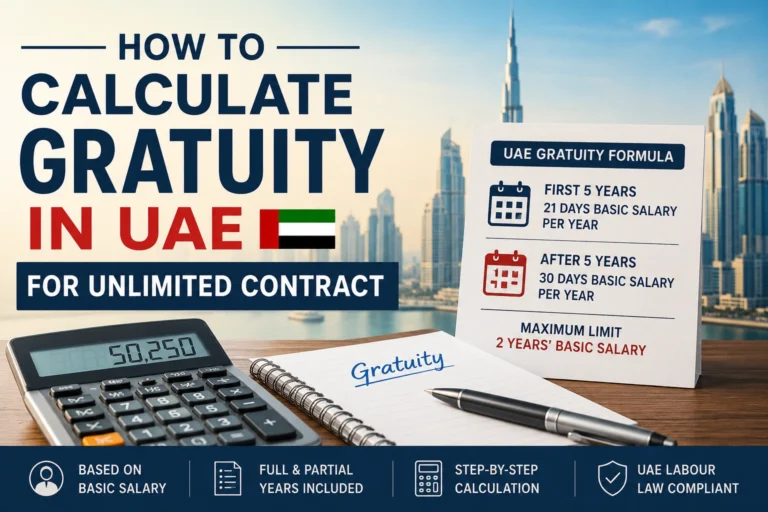
UAE Gratuity Calculation Formula
| Service period | Gratuity entitlement |
|---|---|
| First 5 years | 21 days of basic salary per year |
| Each year after 5 years | 30 days of basic salary per year |
| Part-year after first completed year | Proportionate gratuity |
| Maximum statutory gratuity | 2 years’ wage |
Periods of unpaid absence are generally excluded from the service period used to calculate gratuity.
Gratuity Example for Four Years
Assume an employee has:
- Basic salary: AED 6,000
- Service period: 4 years
- Daily basic salary: AED 6,000 ÷ 30 = AED 200
Calculation:
- AED 200 × 21 days = AED 4,200 per year
- AED 4,200 × 4 years = AED 16,800
Estimated gratuity: AED 16,800
Gratuity Example for Seven Years
Assume an employee has:
- Basic salary: AED 9,000
- Daily basic salary: AED 300
- Service period: 7 years
First five years:
- AED 300 × 21 days × 5 = AED 31,500
Following two years:
- AED 300 × 30 days × 2 = AED 18,000
Total estimated gratuity:
AED 31,500 + AED 18,000 = AED 49,500
Does Resignation Reduce Gratuity?
The current UAE Labour Law does not apply the old resignation-based gratuity reductions that existed under the previous labour law.
An eligible employee who resigns after completing at least one year generally receives gratuity according to Article 51, subject to unpaid absence, lawful deductions and any approved alternative end-of-service scheme.
Gratuity for Part-Time and Other Work Models
End-of-service benefits for employees working under part-time or other approved arrangements may be calculated according to the employment model and the Executive Regulations.
The calculation may consider the worker’s contractual hours compared with full-time working hours.
UAE Labour Law reference: Article 52. Executive Regulation reference: Article 30 of Cabinet Resolution No. 1 of 2022.
Alternative End-of-Service Savings Scheme
Eligible employers may participate in an approved voluntary savings scheme as an alternative to the traditional gratuity system.
Under this arrangement, employers make regular contributions to an approved investment fund for enrolled employees.
Workers should check:
- Enrolment date
- Monthly contributions
- Salary used for contributions
- Selected investment option
- Benefits earned before enrolment
- Withdrawal procedures
- Treatment of unpaid leave
Traditional gratuity may continue to apply to service completed before the employee enters the savings scheme.
Final Settlement After Employment Ends
An employer must pay the worker’s wages and other end-of-contract entitlements within 14 days from the employment termination date.
A final settlement may include:
- Unpaid salary
- End-of-service gratuity
- Unused annual leave
- Notice-period compensation
- Earned commission
- Contractual bonuses
- Reimbursable expenses
- Other agreed benefits
- Lawful deductions
Employees should request an itemised calculation rather than signing a document containing only a total amount.
UAE Labour Law reference: Article 53.
Documents to Request Before Leaving a Job
An employee should obtain or verify:
- Final settlement statement
- Experience certificate
- Work permit cancellation
- Residence visa cancellation where applicable
- Salary records
- Leave balance
- Gratuity calculation
- Commission statement
- Copy of the signed cancellation document
The employer must provide an experience certificate at the employee’s request without charging a fee.
UAE Labour Law reference: Article 13.
Passport Retention
An employer must not withhold an employee’s official documents.
A passport may be handed over temporarily for a legitimate visa or administrative procedure, but it should be returned after that procedure is completed.
Employees should retain copies of their passport, Emirates ID, visa, work permit and employment contract.
UAE Labour Law reference: Article 13(2).
Workplace Safety Responsibilities
Employers must provide a safe and suitable working environment.
Depending on the nature of the workplace, responsibilities may include:
- Safety instructions
- Protective equipment
- First-aid facilities
- Emergency procedures
- Hazard warnings
- Training
- Clean workplace facilities
- Heat-stress controls
- Reporting workplace injuries
- Protection from violence and harassment
Employees must follow safety rules and use protective equipment correctly.
UAE Labour Law reference: Articles 13, 16 and 36.
Workplace Injuries and Occupational Diseases
An employer must follow the required procedures when an employee suffers a workplace injury or occupational disease.
Depending on the case, the employer may be responsible for:
- Medical treatment
- Reporting the incident
- Wage payments during treatment
- Compensation for permanent disability
- Compensation following a work-related death
Compensation may be refused in limited circumstances, such as deliberate self-injury or misconduct falling within the legal exclusions.
UAE Labour Law reference: Articles 37 and 38.
Workplace Harassment, Bullying and Violence
Sexual harassment, bullying and verbal, physical or psychological violence against an employee are prohibited.
The restriction applies to conduct committed by:
- The employer
- A manager
- A supervisor
- A colleague
- Another person working with the employee
Employees should preserve emails, messages, witness details, medical reports and copies of complaints submitted to HR or management.
UAE Labour Law reference: Article 14.
Non-Compete Clauses
An employer may include a non-compete clause where the employee’s duties give access to clients, customers or confidential business information.
To be enforceable, the restriction should be reasonably limited by:
- Duration
- Geographic area
- Type of work
- Legitimate business interest
The non-compete period cannot exceed two years after employment ends.
The clause may not apply where the employer terminates the employment contract in violation of the law. The employer generally carries the burden of proving damage resulting from a breach.
UAE Labour Law reference: Article 10. Executive Regulation reference: Article 12 of Cabinet Resolution No. 1 of 2022.
Employment of Workers Aged 15 to 18
Children below the age of 15 cannot be employed in the UAE private sector.
Workers aged 15 to 18 may work only under regulated juvenile employment conditions.
Requirements may include:
- Written consent from a parent or guardian
- Medical fitness certificate
- Juvenile work permit
- Limited daily working hours
- Mandatory breaks
- No overtime
- No night work
- No hazardous work
- No work on official holidays or rest days
UAE Labour Law reference: Article 5.
Disciplinary Penalties
An employer may impose disciplinary penalties only in accordance with the law and applicable workplace regulations.
Possible penalties include:
- Written warning
- Written notice
- Wage deduction within legal limits
- Suspension without pay for a limited period
- Withholding a periodic raise
- Withholding promotion
- Dismissal while preserving end-of-service rights
The penalty should be proportionate to the violation. Employers must follow investigation and notification procedures before imposing serious disciplinary action.
UAE Labour Law reference: Articles 39, 40 and 41.
Unlawful Absence From Work
An employee who is unlawfully absent before the contract ends may face restrictions on obtaining another work permit.
A foreign employee who leaves work for an unlawful reason before the contract expires may be prevented from receiving a new work permit for one year, subject to exceptions established by the Executive Regulations.
Employees should submit resignation in writing and comply with notice and cancellation procedures to reduce the risk of an absence complaint.
UAE Labour Law reference: Article 50.
Changing to Another Employer
An employee may move to another employer after the employment contract ends where the legal and administrative requirements are satisfied.
A transfer may also be permitted during probation or after termination in circumstances recognised by law and the Executive Regulations.
Employees should ensure that their current work permit is correctly cancelled or transferred before beginning work for a new employer.
UAE Labour Law reference: Article 49.
How to File a UAE Labour Complaint
Employees and employers should first attempt to resolve the dispute through clear written communication.
Where the issue remains unresolved, a complaint may be submitted to MoHRE.
UAE Labour Law reference: Article 54.
Step 1: Collect Supporting Documents
Prepare:
- Passport
- Emirates ID
- Work permit details
- Employment contract
- Job offer
- Salary records
- Bank statements
- Attendance records
- Leave records
- Resignation or termination letter
- Emails and messages
- Final settlement calculation
Arrange the documents by date and identify the exact amount or remedy being claimed.
Step 2: Submit the Complaint
Clearly explain:
- What happened
- When it happened
- Which contractual or legal right was affected
- Amount being claimed
- Steps taken to resolve the issue
- Outcome requested
MoHRE may contact both parties and attempt an amicable settlement.
Step 3: Attend Mediation
Both parties should respond to official calls and attend scheduled complaint sessions.
Failure to cooperate may delay settlement, work permit cancellation or referral to court.
Step 4: MoHRE Decision or Court Referral
MoHRE may issue an enforceable decision in an individual labour dispute where the value of the claim does not exceed AED 50,000.
The Ministry may also issue a decision where a party fails to comply with an amicable settlement previously approved by MoHRE.
A party may challenge the Ministry’s decision before the competent Court of Appeal within 15 working days after notification.
UAE Labour Law reference: Article 54, as amended.
Time Limit for Filing Labour Claims
Employees and employers should not delay when raising a labour dispute.
The applicable limitation period is set by the current wording of Article 54 and may be affected by the date the employment right became due, subsequent amendments and the circumstances of the claim.
Because limitation rules can determine whether a claim is accepted, affected parties should submit complaints promptly rather than waiting until the end of the available period.
UAE Labour Law reference: Article 54, as amended.
Common UAE Labour Problems and Solutions
Salary Has Not Been Paid
Confirm the payment date in the contract and check the bank account information provided to payroll.
Send a written request to the employer. If the salary remains unpaid, submit a complaint supported by the contract, bank statement and unpaid salary calculation.
Relevant law reference: Article 22.
Employer Refuses to Accept a Resignation
Submit the resignation through a traceable method such as email or an HR portal.
Continue serving the required notice unless the employer agrees to shorten it or a lawful reason exists for leaving without notice.
Relevant law reference: Articles 43 and 45.
Employee Is Asked to Sign a Blank Settlement
Do not sign a blank or inaccurate final settlement.
Request an itemised calculation showing salary, gratuity, leave, notice pay, commission and deductions. A signed declaration stating that all dues were received may make a future claim more difficult.
Relevant law reference: Articles 29, 51 and 53.
Employer Does Not Cancel the Work Permit
Ask for cancellation in writing and keep proof that employment has ended.
If the employer refuses or fails to cooperate, raise the issue through MoHRE and provide the resignation, termination letter or labour decision.
Relevant law reference: Articles 6, 42 and 49.
Gratuity Appears Too Low
Check:
- Last basic salary
- Joining date
- Final working day
- Unpaid leave
- First five years of service
- Service completed after five years
- Alternative savings scheme participation
Allowances are normally excluded from the statutory calculation.
Relevant law reference: Article 51.
Employee Leaves Without Completing Notice
The employer may claim compensation for the unserved notice period unless the employee had a valid legal reason for immediate departure.
Any agreement to reduce or waive notice should be recorded in writing.
Relevant law reference: Articles 43 and 45.
UAE Labour Law Checklist for Employees
Employees can protect their rights by taking these steps:
- Read the job offer before accepting it
- Compare the offer with the official contract
- Keep copies of all signed documents
- Check salary deposits monthly
- Record overtime and attendance
- Monitor annual and sick leave
- Submit resignation in writing
- Keep proof of notice-period attendance
- Request an itemised final settlement
- Review the gratuity formula
- Do not sign incorrect payment declarations
- Submit complaints without unnecessary delay
UAE Labour Law Checklist for Employers
Employers should:
- Issue accurate employment contracts
- Obtain the required work permits
- Pay salaries on time
- Maintain payroll and attendance records
- Apply leave rules consistently
- Record overtime correctly
- Document warnings and investigations
- Protect employees from harassment
- Maintain a safe workplace
- Calculate final dues correctly
- Complete cancellation procedures promptly
- Respond to MoHRE complaints
- Avoid charging workers recruitment fees
Frequently Asked Questions About UAE Labour Law
What is the current UAE Labour Law?
The current UAE Labour Law for most private-sector employment is Federal Decree-Law No. 33 of 2021, as amended, together with Cabinet Resolution No. 1 of 2022. It regulates employment contracts, wages, working hours, leave, workplace conduct, termination, gratuity and labour disputes across the private sector.
What are normal working hours under UAE Labour Law?
Under UAE Labour Law Article 17, normal private-sector working hours are generally eight hours per day or 48 hours per week. Employees should not normally work for more than five consecutive hours without breaks. Different limits may apply to certain sectors, shift systems and approved flexible-working arrangements.
How much annual leave does an employee receive in the UAE?
UAE Labour Law Article 29 provides 30 days of annual leave after one completed year of service. Employees who have completed more than six months but less than one year receive two days for each month. Unused leave is normally paid from basic salary when employment ends.
What is the maximum probation period in the UAE?
The maximum probation period under UAE Labour Law Article 9 is six months. An employer terminating employment during probation generally provides 14 days’ written notice. An employee leaving the UAE normally gives 14 days, while someone moving to another UAE employer generally gives one month’s notice.
How is gratuity calculated under UAE Labour Law?
UAE Labour Law Article 51 calculates gratuity using the employee’s last basic salary. Eligible workers receive 21 days of basic pay for each of the first five years and 30 days for every additional year. A proportionate payment applies to part-years after one completed year of service.
Can an employer terminate an employee without notice?
UAE Labour Law Article 44 allows dismissal without notice only for specific serious violations. These include document fraud, serious safety breaches, disclosure of business secrets, assault and excessive unlawful absence. The employer must generally investigate the incident and deliver a written, reasoned dismissal decision to the employee.
How long does an employer have to pay final dues?
Under UAE Labour Law Article 53, employers must pay outstanding wages and other end-of-service entitlements within 14 days after employment ends. The settlement may include unpaid salary, gratuity, unused leave, notice compensation, commission and other contractual amounts, less deductions that are legally permitted.
How can an employee file a labour complaint in the UAE?
An employee may file a complaint with MoHRE under UAE Labour Law Article 54. The worker should provide the employment contract, salary records, correspondence and a clear calculation of the claim. MoHRE may facilitate settlement, issue an enforceable decision in eligible cases or refer the dispute to court.